Table des matières
Introduction
The current global trend towards biodiversity and ecosystem service losses, coupled with the likely increase in demand for food and continual inequities in food systemsn disfavoring arid zones, is especially concerning with regard to agriculture and could limit the world’s ability to move towards global food security and meet nutritional requirements for the world’s population (Tomlinson, 2013).
Reversing the trend of environmental degradation by rebuilding natural capital is a new option of the Moroccan Government. Actually, a project entitled: “A Circular Economy Approach to Agro-Biodiversity Conservation in the Souss-Massa Draa Region of Morocco” has recently been implemented under the Integrated Nature Resources Management in the Middle East and North Africa Region UNDP Program. The project focused on the Inzerki pilot area, a Site of Ecological and Biodiversity Importance (SEBI) located in the Argan Biosphere Reserve (ABR) and where one of the biggest traditional apiary was set to foster connection between the Saharan yellow bee, an endemic species of North Africa deserts, and its melliferous natural habitat (UNDP morocco, 2014).
Methodology
A literature review was conducted to shed light on the key decisive roles PES schemes could play in implementing the Inzerki management plan. This review, coupled with a specialized technical assistance, figured out a systems thinking model based on the circular economy approach embedding PES and Eco branding.
The circular economy approach
To this end, the Inzerki management plan ought to converge towards circular economy, outlining a three-pronged strategy (World Bank, 2012):
Eco conception by Thinking in ‘environmental systems’:
- Tailor inclusive green growth strategies, with an emphasis on conservation, sustainable development and supporting issues;
- Build resilience through agro-diversity preservation within the main value chains: argan oil and honey,
- Eco branding.
Meet up-front capital needs with innovative financing tools
- Introduce PES and fair trade systems into core value chains;
- Ensure an equal value distribution by integrating natural capital into accounting.
Promoting the social capital stock
- Structure the sector and promote a collective approach of communication.
- Protect and promote human rights enhancement within value chains.
More evidence to pave this way were demonstrated in reports from emerging countries showing that a circular economy path to development could bring additional annual benefits ranging from 10 to 40% of current GDP (Andrew Morlet et al., 2017)
1.2- Payment for ecosystem services
Ecosystem services are the benefits people obtain from ecosystems. These include: Provisioning services such as food, water, timber, and fiber; Regulating services that affect climate, floods, disease, wastes, and water quality; Cultural services that provide recreational, aesthetic, and spiritual benefits; and Supporting services such as soil formation, photosynthesis, and nutrient cycling (MEA, 2005). These services refer to conditions and ecological processes that sustain human well-being (Daily 1997).
PES schemes represents an intuitive tool to periodically reward private landowners or communities, through annual cash or in-kind payments, for delivering additional conservation benefits (subject to a time-constrained agreement and strict conditionality). PES has been touted for their purported economic and ecological effectiveness, flexibility, and directness (Ferraro, P. J. et al, 2002). However, research pertaining to their effectiveness in different contexts remains inadequate to draw generalized conclusions (Miteva et al., 2012).
Today, it is well documented that PES are effective market based instrument to conserve biodiversity. And since honey bees dominate in providing pollination services to several plants and natural habitats, their conservation is important to realize the potential yields of several crops as well as conservation of rare and endemic species in natural habitats (Meena Thakur, 2012) through PES.
– Certification as environmental incentive system
Certification for ecosystem services could be defined in three different ways (Erik Meijaard et al, 2011):
- Certification of PES schemes to demonstrate that they are ‘sustainable’ in terms of economic, social and environmental impacts;
- Certification of PES schemes to demonstrate that they actually deliver ecosystem services from land use/management (i.e. verification of service delivery);
- Certification that existing PES schemes or certification schemes e.g. carbon, timber etc. provide additional ecosystem services, other than what is being paid for e.g. watershed services from land-based carbon offset projects.
The second option that certifies PES schemes based on of service delivery fits into our specific local needs.
– Mainstreaming ecosystem services into honey value chain,
– Overview of challenges and potential for PES schemes
- The main challenges facing the honey populations are listed below:
- Most global circulation models predict a drop of 4 to 27 % in annual rainfall and an increase in drought patterns mostly in summer time (Elrafy, 2009) as a consequence of climate change in North Africa. These effects coincide with blossoming periods and intense foraging. Although, the magnitude of this effect has not been yet assessed accurately on melliferous habitats and bee populations and diseases, there is strong evidence that these environmental disruptions would drastically affect the honey value chain over the next decades (Radouane, 2013).
- At the Inzerki site, it is common that overgrazing and overuse of aromatic and medicinal plants affects the foraging capacity and lead to social conflicts particularly during drought periods.
- Pathogens & pests: the Varoa and the diamondback moth are the most destructive pests that threatens bee colonies at the Inzerki site.
- Invasive species of the European black bees is threatening the yellow sarahan bees, native to North Africa.
- Use of pesticides in intensive agriculture area, where most bee keepers seeks supplemental forage resources, is anther serious threat to bee populations.
– Bee pollination as an Ecosystem Service
Today, the SMD region counts about 99,500 hives. Spurge Honey, thyme honey and orange honey contributes to nearly 80 % of the total volume of honey production standing approximately at 1000 Tons (DRA SMD, 2015).
Honey bee pollination services are also traditionally admitted to contribute substantial benefits to human populations and agriculture particularly. Saharian bees (Apis mellifera) provide the majority of these services to selective agriculture crops in the Souss area, like almonds, apples, avocado, citrus, cucumber, oignon, etc.
Primary economic valuation of honey value chain at the Inzerki site, home of a thousand bee colonies, reveal a total annual honey value of MAD 4 Million, while its the potential contribution to modern agricultural production based on value transfer methods (Nicola Gallai & al.2009 et IPBES, 2019) stands at MAD 6 Million.
Monetization of the value of bee pollination services could hence be used as an environmental finance initiative to unlock resources to conserve biodiversity of natural habitats around the Inzerki apiary.
Ultimately, the most promising PES option is to provide financial support to restore natural habitats through pollination management, grazing set-asides and surveillance of protected areas against overgrazing and unsustainable harvest of aromatic and medicinal plants.
Project’s main outputs
- PES/Eco branding as a market based instrument to conserve biodiversity
The participatory diagnosis carried out at the level of the ecosystems of the Arganeraie Biosphere Reserve resulted in an Eco branding system based on a circular economy approach embedding the following five core sustainability competencies (Wiek et al, 2011):
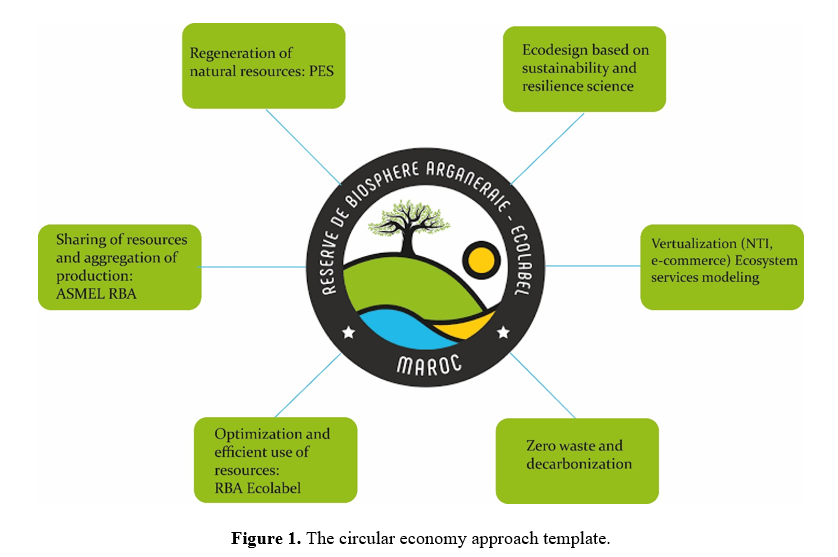
- Systems thinking by enhancing the ability to think about ecological, economic, political and technological systems all together in a way to shift from product to ES oriented honey value chains. Lack of systems thinking in current linear pathways is undermining the sustainability strategies while circular interrelations provide additional dynamic feedbacks. For doing so, the ecolabel standard governance lays on a multi-stakeholder participation approach embedding (i) regenerative practices through PES, (ii) sharing of means of production, (iii) efficient use of resources, (iv) commitments by integrating and enacting the pollination charter, (v) virtualizing the honey value chain, and (vi) teaming up with universities to advance science of sustainability and resilience (Fig.1).
- Future thinking using plausible tools brought about by the fourth industrial revolution. These include using New Information Technologies to set ES modeling and allow E-commerce transactions, Artificial Intelligence, genetic engineering and environmental economics when possible. All these, put together, will help access global markets in a competitive and fair way.
- Normative thinking by considering what sets of values other individuals, groups or parts of the world may have and would influence our decisions. Today, private branding are proven to be successful for their ability to upgrade and thrive in global markets through benchmarking. For this purpose, teaming up with the Global Ecolabel Network and the Global membership association for credible sustainability standard is underway.
- Strategic thinking helps decide which mechanism in terms of economic incentives, institutional or policy instruments to put in place in order to achieve the desirable future. For doing so, the Morocco Green Plan aggregation model set out for honey value chains will integrate the ecolabel.
- Collaborative thinking helps providing the ecolabel managers with tools and techniques that enhance collaborative skills. To this end, appropriate communication tools, including forums, social media networks are being developed to facilitate exchange and innovation.
To manage the new ABR eco-label according to the above mentioned principles, the Argan Biosphere Reserve. Ecolabel Moroccan Association (ABR.EMA) has recently been founded with the goal to certify local entities that are biodiversity friendly and meet food safety requirement. The ultimate goal of the ABR.EMA is therefore to set up a sustainable production and consumption standard in the ABR that could be progressively be expanded to the national Biosphere Reserves and eventually to the whole MAB/UNESCO world network of biosphere reserves. The ABR.EMA standard covers all domestic products and services, including among others, Argan oil, Honey, Aromatic and medicinal plants and tourism. The board of directors is composed of 15 elected members and the executive board is managed by 7 members.
– Enabling Institutions and Regulations
The proposed circular economy model applied to honey sector should be sustained by four basic pillars: Legal Framework, Institutions, Financing, and Governance.
– Legal framework
Although the Moroccan legislation contains only one specific PES law (compensation for deferred grazing in forest areas), it does include numerous laws that use PES-like instruments ( Law 11-03 on the Preservation and Valuation of the Environment, Law 39-12 on organic production and Law 25-06 on certification of quality of agricultural products, Law 22-07 on Protected Areas…). Yet these legislative texts are to be revised in order to integrate PES regulations (Allali K, 2011).
– Institutions
Given that the proposed Ecolabel/PES model will have impacts on the argan ecosystem, the analysis of the institutional framework should consider both the role of public and private entities in PES transactions and management of the BR ecobranding.
Therefore, the project is carrying out an international benchmarking to seek appropriate frameworks that fit into national regulations. The proposed private standard will likely be reinforced by a joint forest management where the forestry department and local communities are called to play decisive roles.
– Financing
PES schemes will draw from both national and private funds. Economic valuation were carried out to define the level of PES on a cost recovery basis. The evaluation recommend to revise upward the public compensation for grazing setting asides in the argan forests from the current level of 350 Dh/ha to +MAD 700/ha. While private PES will draw from the ecolabel added value at a tune of MAD 10 /kg of labeled honey. Collected funds will benefit to local right holders against formal engagement to implement best practices of restoration (grazing setting asides in protected areas of high spot of melliferous habitats; transhumance of bees around protected areas and protection of bee-hives….).
– Governance
The ABR.EMA is devoted to manage and monitor the Ecolabel standard and enact contractual arrangements with potential partners, including:
- Local and regional government (local communities);
- High Commission for Water and Forests and Fighting against Desertification
- Local right holders associations
- Ecolabel promoters (Cooperatives, companies, …)
- Certification bodies.
Conclusion
The paper aims to identify market based instruments that could help reverse the degradation of the argan ecosystem and associated bee habitats by focusing on innovative PES.
The following initiated public or private PES schemes should however be complementary and mutually reinforcing through a credible and cost effective ABR EMA Standard:
- The Public developed PES schemes regarding compensation for grazing set-asides;
- And the ABR eco-certification associated to PES offering an opportunity of joint forest management involving apiculturists to strengthen resilience of restored natural bee habitats and ensure sustainability of their supply chains.
Références bibliographiques
Allali, K. 2011. Services environnementaux, agrotourisme et réduction de la pauvreté. ROA, INRA et FAO, Dossier spécial, n° 2, Publications de l’ENA de Meknès, Morocco.
Morlet A. & al., 2016. Circular economy in India : Rethinking growth for
long-term prosperity. Ellen Macarther Foundation.
Benchekroun, F. 2014. Ecosystem services valuation in the argan Biosphere reserve. Symposium act PNUE, University of Al Akhawayne and the University of Minnesota. Rabat.
Daily, G. C.1997. Nature’s services. Island Press, Washington, DC.
DRA SMD, 2015. Cahier des charges du miel de thym dans la zone d’Ida Ou Tanane, bibliothèque DRA, Agadir.
Elrafy, M. 2009. Impact of Climate Change: Vulnerability and Adaptation of Coastal Areas. Report of the Arab forum for Environment and Development. Mostafa K.Tolba and Najib W. Saab Eds.
Meijaard E., Sheil D., Manuel R. Guariguata, Nasi R., Sunderland T. and Putzel, L. 2011. Ecosystem services certification Opportunities and constraints, CIFOR.
Ferraro, P. J., & Kiss, A. 2002. Direct payments to conserve biodiversity. Science, 298(5599), 1718–1719.
IPBES, 2019. Global Assessment Report on Biodiversity and Ecosystem Services.
Redouane L., 2013. Climate change impacts on North African countries and on some Tunisian economic sectors. National Tunisian Institute for Agriculture Research (INRAT)
MEA 2005. Ecosystems and Human Wellbeing: Synthesis. Island Press, Washington DC.
MAPM, 2010. Projet Intégration du Changement Climatique dans la mise en œuvre du Plan Maroc Vert « PICCPMV », ADA, Rabat.
Meena Thakur, 2012. Bees as Pollinators – Biodiversity and Conservation. Central Potato Research Institute Shimla-India.
Millennium Ecosystem Assessment 2005. Ecosystems and Human Wellbeing: Synthesis. Island Press, Washington DC.
Miteva, D. A., Pattanayak, S. K., & Ferraro, P. J. 2012. Evaluation of biodiversity policy instruments: what works and what doesn’t? Oxford Review of Economic Policy, 28(1), 69–92.
Gallai N. & al., 2009. Guidelines for the economic valuation of pollination services
at a national scale. FAO.
Tomlinson, i. 2013. Doubling food production to feed the 9 billion: a critical perspective on a
key discourse of food security in the UK. Food Security, 29: 81–90.
UNDP–Morocco, 2013. A Circular Economy Approach to Agro-Biodiversity Conservation in the Souss-Massa Draa Region of Morocco, Project document, Rabat.
Wiek et al., 2011. key competencies in sustainability: A Reference Framework in Program Academic Development. Sustainability Science: 6 (2) 203-218.