
Table des matières
- 1 Introduction
- 2 Social Media and Tourism
- 3 Social media as an influencer of decisions
- 4 The impact of social media on tourism patterns
- 5 Social Media and its influence on Qatari tourism
- 6 Methodology
- 7 Research Results & Discussions
- 8 The Popularity Factor
- 9 The Social Media Influence Factor
- 10 The Reliability Factor
- 11 The Impact of Social Media on Tourism
- 12 Conclusion
Introduction
As technology is growing at a very fast pace, it has become evident that its effects on everyday life can no longer be ignored even to the minutest of spheres of existence. As generalist as this may sound, it is, however, true even for the tourism industry. Research indicates that from the year 1980 it took tourist arrival figures to gain by about 390 million by the year 2000, but, at the advent and growth of the technology bug this figure had reached an astonishing 1, 2 billion tourist arrivals in different destinations around the globe by the year 2015 (UNWTO, 2016). This indicates that tourist arrival growth figures increased at a quarter less the time it had taken from the 80s to the 00s stage.
Further studies indicate that attributable to this growth in tourism figures is social media (Dwivedi et al., 2011). This study indicated a huge reliance by National Tourism Organization bodies around the globe on their dependence and use of social media. Further, in a 2018 dissection of the effects and impacts of social media on tourism growth and in general, the Hospitalitynet organization indicated that since it became popular, social media has been the go-to play ground for holiday seekers (Hospitalitynet, 2018). According to this study, there has been a steady growth in the utility of such social media sites such as Trip Advisor (to mention just one of the most popular), from which the data gathered in that study indicated that compared to 2005 where there were far less than 50 million reviews and opinions on the site, by the year 2015, that figure had reached a staggering 200 million reviews and opinions, thus indicating such a sharp rise in the impacts that social media has had for tourism related issues (Hospitalitynet, 2018).
Locally, by the year 2013, Qatar had the largest footprint of internet penetration in the whole of the Gulf region, standing at 88.1%, with most of these figures indicating that most individuals accessed this usage via smart phones or laptops mainly (Ministry of Transport and Communications (MoTC), 2013). This report also showed that on spending at least 2 hours daily on the internet, 45% Qatari nationals visited a social media site at least once daily with Facebook being the most visited and used platform amongst the rest cited (MoTC, 2013). Of the local sites that were indicated to top the list, Qatar Living.com and ILoveQatar.com sites came out tops. A further report by the same ministry (MoTC) in 2014 just about confirmed the above retorts with just the addition of WhatsApp together with Facebook being the most widely known and utilized social media platforms (MoTC, 2014).
The question then arises of why these statistics are pertinent for Qatar? The fact of the matter is that social media has become intertwined with everyday life to an extent it has become almost indispensable to the average person who is dependent on online information to go about their day, be it on current or for -future purposes. This in turn intimates that tourists may also rely and depend on social media information to plan any vacations they may need to take. This has then motivated a focus on a research expedition on the usage of social media in attracting tourists to Qatar and the impacts it has on the whole tourism industry in the country.
The data provided thus far has shown that social media usage has become part and parcel of our everyday existence and with it information dissemination. The issue then lies in the fact that this information is often not sifted, formalized or strictly monitored (save for programme violations by some users) and as such the potential for harmful information getting perpetuated to the world is quite high. In much the same length, the potential for good information is also high. However, looking at this from the point of view of tourism, information that is harmful is bound to hurt businesses that provide such services to visitors.
Furthermore, looking at the juncture of progression and growth in which Qatar currently finds itself, it is safe to conclude that more of the good information being passed around in social media circles, would actually be a positive booster for the tourism industry.
A further issue at hand is also that (as data will show), information currently gleaned from these social media sites has tended to be disjointed. Without a centralized theme of focus in terms of specific matters that can be utilized positively to assist in image enhancement, this information has rather been ‘individualistic’ to tourism entities that have been mentioned in such social media sites. An example would be a hotel brand that gets reviewed by its guests. Such hotel will only be focused on its self-imagery and may then implement measures that are pertinent to itself only and not necessarily holistic in boosting the grander national image of the tourism sector in unison with other brands. Based on these assertions therefore, our problem statement of choice will thus be; “How may Qatar leverage the growth of the tourism sector through social media interaction with potential and existing visitors in a manner that will be more attractive for them?”
Social Media and Tourism
The issue of social media and its influence on the tourism sector and its growth on a broad scale has been one that has received much attention from the academic field (Chatzigeorgiou, 2017; Zeng & Gerritsen, 2014; Mariani et al., 2014; Conrady & Buck, 2007) because of its multi- dimensionalism and its ability to be adaptable to changing trends and will most likely be a topic of research and discussion into the infinite future. Social media has played a very pivotal and specific role in the influence that it has had on tourists’ movement patterns to various global destinations and it is perhaps vital that a diagnostic study is undertaken for some of those destinations such as in our current focus of study – Qatar.
At the turn of the millennium (around about the year 2000), technological influence and manifestation had not been at such a level as it is currently being felt and experienced (Internet World Stats (IWS), 2019), with the internet exploding as a recognized and relied upon platform for information dissemination from about that year. Figures presented indicated that in December 2000, there were about 361 million internet users globally with this number increasing to about 2 billion users by the year2010 (IWS, 2019). That figure has more than doubled to date. Statistics also show that around 2004, two phenomena in the technological space basically revolutionized the internet as we know it today. First was the proliferation of social media (such sites as Facebook were born around that time) and secondly, the popularity of mobile phone technology also saw a sharp increase in usage (IWS, 2019). Statistics showed that at a later stage (around 2013), the popularity of Facebook had grown so dramatically to an extent of a user base of around 1.23 billion users per 14 month tallying and 945 million active users accessing it from their mobile devices. Sister application, Instagram, had scored a user base of 150 million users by the close of 2013, cementing an increase of15% from the previous two month figures. LinkedIn, on the other hand, had nearly 280 million subscribers of its platform at that period as well (Scaife, 2014).
What was unmistakably evident from this era onwards, was the dependence by the millions of internet users in the ease of communicating through the various social media platforms. This cemented the one thing that would later become an asset for even businesses the world over and that was, the influence of social media on decision making.
Social media as an influencer of decisions
Research is abound on the aspects of social media being an object and tool of influencing decision making since the mid- 2000s. This has been prevalent on the aspect of social media being a marketing tool through which various stakeholders can leverage its potential to further their interests be it in business or just as a past-time in engaging with family and friends (Chatzigeorgiou, 2017). As such little attention has been given to social media itself as a conduit of strategic decision making, in essence making it an influencer of decisions that get made by its users (Bowen & Bowen, 2016). Bowen & Bowen (2016) intimated in their research that social media content could actually be used in a purposive approach to decision making. In a way they surmised that social media could not be divorced from the act of making a decision as it was a pattern based repeat approach which could be monitored to enhance the decision making process.
On the other hand, a study indicated that the influence of social media was such as to affect how rational and effective a decision could be made from both a negative and positive aspect (Power & Phillips-Wren, 2011). The study indicated at the improvements that have come to be made on the platforms that hub the social media communicative tools and as such with the improvements to technology, the generation of user content from these platforms in terms of combined, edited and archived content, can now be easily shared. The only preserve is that this content, in the form of opinions and ideas, is ‘raw’, that is, it is neither reviewed, censored nor evaluated for quality. This is where the perception of rationality and effectiveness gets tested (Power & Phillips-Wren, 2011).
Hajli (2014), noted in one of his research works that through online communities as well as through many of the popular social media platforms (Facebook, WhatsApp, Instagram, etc.,), the continuous exchanges and interactions taking place between users of these, intimated at social media as being pivotal to creating an environment where they could either trust or not trust a specific product or service and even providers of such. The rational was that a wide scale of users of these social
platforms gave value and put trust in the act of sharing about products, places or services that occurred through social media. The ensuing implication was then that based on the reviews (comments and reactions to posted content be they positive or negative) to such posts, trust was likely to increase (or dwindle) influenced by what followers or commentators thought about the subject of the post (Hajli, 2014).
What is evident thus far, is the fact that it seems social media is much infused in decision making for both individuals and entities and this could be said even for the tourism industry. This is especially so on the growth of the industry through the decisions that users of these platforms make in terms of holiday destinations which then has a broad effect on tourist number fluctuations for such destinations.
Research indicates that social media is a pivotal and vital player in many facets of tourism. This is especially so when information is being sought and for the determination of what drives particular and specific decision-making tendencies by consumers within the industry, the promotion of tourism products and services and basically seeking the most prevalent and best suited interactive courses with existing and potential clients for tourism businesses (Zeng & Gerritsen, 2014). This is why under the marketing umbrella, social media has been leveraged, for tourism, as a brilliant strategy.
Another study also uncovered that most studies have been undertaken under the banner of consumer-centric studies and that these have mainly had as a focal point, the uses and impacts of social media in establishing the processes that travellers go through in the planning stages of travel (Fotis et al., 2012). This study essentially found that the exact or critical stage of utility of social media by travellers was indicated to be most prevalent at the end of a journey (loosely translated as a holiday), where reviews were given about that particular destination. As such these opinions and reviews (which an earlier study found are often not monitored or evaluated) provide as authentic a feedback as any review platform can offer (Fotis et al., 2012). It is here, that this study found, that decisions by other consumers get changed either against a particular destination or actually to opt for it as a final place to visit. This user-generated
information was also found to be most relied upon by travellers much more than official tourism sites or agencies could sell a particular destination (Fotis et al., 2012).
These and more studies have indicated the foundational importance of social media in driving and influencing the tourism industry on a global scale and this influence does not likely seem will wane anytime soon. However, an aspect of interest is whether all this influence has had the same effects on Middle Eastern countries, especially Qatar as much as it has on Western or foreign countries, as much of the studies seem to have been focused on them? Does social media have the same influence and eventually effects on the trajectory of the tourism industry of this small Gulf nation?
Social Media and its influence on Qatari tourism
Findings on an academic scale have indicated at the importance of social media as a mode of creating competition within the tourism sector. As such many supplier- related studies have focused mainly on the management of tourism offerings, promotions, research functionality and yet some on product distribution which all havean effect on the decision making process by the traveller (Zeng & Gerritsen, 2014; Fortis et al., 2012).
Govers (2012) pointed out that at the time his research was conducted, the city of Dubai was the main buzz word on social media platforms, in terms of the leading Middle Eastern destinations to visit, with more of its positive attributes drowning out the competition. Bahrain also attracted a lot of attention, however, it was for all the negativity that was associated with mainly political matters. Qatar had just won the mantle to host the FIFA 2022 Soccer World Cup, but, that on its own did not boost much, the country’s image as a favorite destination for visitors. What more, the selection process had been marred with controversy (France24, 2019). These were (and still are) some of the issues that have added to the slowing down of the tourism industryin Qatar with social media perpetuation of the situation also being central to the contributions of this imagery that the country faces.
The MoTC in a recent study (MoTC, 2014), surveyed that 85% of social media users in Qatar intimated at the negative uses of these online platforms in spreading falsehoods, further deepening the impact of social media on the country’s image. The Ministry’s study also found that in the Middle East (of which Qatar is included) much of the research on social media interaction has focused on the growth of the usage of social media platforms without necessarily scrutinizing the reasons for this up-take or the impacts of the evolution of the behaviors of the users (MoTC, 2014).
On the other hand, a study found that in some sections of the tourism industry, vast quantities of data, in the form of reviews, ratings and feedback) have been gathered from social media platforms to better understand the context of users in the identification of useful cultural heritage resources and thus geo-tagging, ranking and classifying them (Nguyen et al., 2017). This was done so as to achieve seamless and smart interactions between tourism service providers and visitors of the environments of smart tourism.
What has been made clear so far is that social media has played (and continues to do so) a central role for tourism sectors around the different parts of the world in a very deep and clear manner. For Middle Eastern countries, Qatar included, it does seem like even though social media usage is high and prevalent, it seems there still is much that tourism authorities can still learn and do to implement in the development of strategies that will enhance the growth of the sector and thus attract more visitors to the country.
Methodology
The research design adopted was that of deduction favored in the stead of inductive reasoning. A deductive understanding towards research deals with largely and generally, theory testing (Bell et al., 2015). In the present research, this approach was favored in ascertaining if data collected was consistent with any previous theories, hypotheses and assumptions forwarded in this regard through other research outputs. Its premise is based on beginning with an analysis of the generalized understanding of the subject matter with a drive towards concluding with an inference on the individuality of the subject matter (Thomas, 2006). Another reason for adopting a deductive approach was a consideration on the time and resource constraints that mayhave been limiting with an inductive approach as it takes time to unfold research work through it.
It was therefore recommended that the survey methodology of data collection would be employed, together with the assessment of secondary data from existing research articles to provide conclusions and recommendations.
The target audience was targeted at places and locations that are considered as the ‘tourist hotspots’ in Qatar, where there is an untold general consensus that one is sure to come across a number of tourists enjoying their time in the country. These have been mentioned as the Souq Waqif (a place of great and important cultural heritage for the Qatari people which is also world famous for making available all types of souvenirs and trinkets that showcase the rich history of the Gulf nation) and the Corniche Promenade (which is basically a 5km long stretch of the main water front in Qatar.
A random target audience of 235 respondents was targeted and distributed to during the data collection period. This number was determined that it would give a higher incidence for plausible results with any chance of spoilt responses being mitigated.
The number of questionnaires was also manageable in this regards. An 80% response rate was received back and analyzed and this did not account for the 10 spoilt responses. The strict standards of questionnaire design and distribution were maintained and adhered to ensure that the data was to be relied upon and that it was also authentic and valid. The composition of the questionnaire was of closed-ended questions which basically meant that the respondents only had to respond to the posed questions without any further elaboration. The questions, however, did contain some which required of the respondents to divulge how social media interaction was likely to influence their decision-making thought processes about a destination. These were then designed to solicit Attitude Statements (highly agree, agree, disagree, etc.) and/or Likert Psychometric Scale (Likely, Less Likely, Highly likely, etc.) type responses. The results of this outcome were then presented in the following manner.
Research Results & Discussions
In this section, the discussion of the findings of the research was conducted andit revealed a very interesting outcome. This discussion phase basically became the conduit through which the primary data could then be related to the secondary sources of information as they were expounded in the earlier review. On an initial assessment, it seemed that the influence of social media platform interactions could not be divorced from the decisions that many tourists take whenever plans are a foot to decide on destinations to visit. In other words, the value that seems lies in the information contained through social media sites in very invaluable for tourism purposes.
The Popularity Factor
One of the most revealing elements of this research was the fact of the popularity of social media on a global scale. The study revealed many facets of how popular social media interactions are in the everyday lives of the people who interact through them. In the research it was firstly revealed that a great number of respondents had had some form of interaction with a social media platform or site, including Qatari social websites, through which their decisions to take some or other action were definitely influenced by such interactions.
This may then have been a picture being painted of how indispensable social media has become in our daily dealings and interactions as individuals. In the year 2000 there had been a steady number of internet users ranging at about 361 million users with the number ballooning to more than 2 billion by 2010 (IWS, 2010). Furthermore, Scaife (2014) had provided in his research that by the year 2013, social media usage had skyrocketed to such astronomical figures, it could have been impossible to not think of any individual or organization which did not involve itself with even a single platform to interact and get their message through.
Literary, Facebook had 1.23 billion users around 2013 with Instagram showcasing about 150 billion users. Interestingly, around the same period of 2013 and 2014, Qatar was reported to have the largest internet usage footprint with an 88% penetration rate and furthermore with Facebook and WhatsApp being the most utilized and accessed social media platforms in the country. The popularity contest as was presented in the primary results could also be imputed to the same study by Scaife (2014) and the statistics from the MoI (2014), which also divulged that Qatari social sites, ILoveQatar.com and QatarLiving.com, were the most popular in the Gulf region. 53% of the respondents had indicated having had access to these and other sites before having made decisions to then embark on journeys to Qatar.
The Social Media Influence Factor
The next prevalent theme to have been explored from the primary results was the influence of social media on decision making especially on deciding on the tourist destination. From a general assessment mode, it was quite evident that social media had a lot of influence in the decision-making process for many individuals as such individuals had some or other opinion about it and how it influenced them.
In a 2017 social study on consumers relying on social media information (Kataria, 2017), the researcher found, in that study, that indeed a great number of people were influenced by their considerations of social media information to eventually make certain purchases on products. This particular research was not necessarily based on any tourism study, but its results could be imputed to suggest that social media holds great sway in decision making activities of consumers, regardless they are for tourism purposes or not.
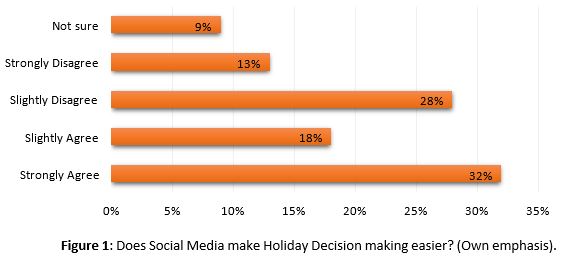
When it boiled down to the nitty-gritties of decision making for travel purposes, the same could still be said for social media platforms holding an influence over individuals to consider certain destinations over others. Bowen & Bowen (2016) actually intimated that social media could indeed be manipulated in a positive manner to influence the decisions that consumers made with regards to destinations they would have loved to visit. This influence was also fertile ground for tourism stakeholders to take advantage of and provide the much-needed influencing information (Chatzigeorgiou, 2017). The overall theme from the primary data also seemed to suggest that a great deal of influential value could be established for social media interactions and that this ultimately had a profound impact on decisions that had been made by the respondents. A good example was information provided below in figure 1, which suggested that a great number of respondents actually thought social media interactions provided for easier decision-making processes to make.
The Reliability Factor
Having established that social media platforms are popular and that they have a considerable influence over the decision making processes for most individuals, the research then went on to look into the very opinions of what the same decision makers thought about the information they come across on the various social media platforms and sites and how much of what they thought eventually found its way to the final decision being made.
The appropriate inquiry in this regards was provided for in Figure 2 below where a greater number of responses dictated that the information from social media platforms was dependable and could be relied upon to make decisions. A study in this regard stated that in 2005 there less than 50 million reviews on the popular travel platform, Tripadvisor and that this figure saw a staggering rise to more than 200 million reviews 10 years later informing the readers of the
exponential increase in users of that platform to inform on thoughts about destinations they had visited (Hospitalitynet, 2018).
When it came to the other information elements such as trustworthiness, honesty and sincerity, it did not seem like these scored highly as the former 2 elements. This could possibly have been due to the fact that its possible a number of reviewers may exaggerate their experiences about a particular place and hence end up reviewing it ‘badly’ thus resulting in an opinion about that place which is skewed (Hospitalitynet, 2018).

The Impact of Social Media on Tourism
Finally, a 2012 study (Fotis et al., 2012) revealed an interesting trend regarding perhaps the most profound impacts of social media on tourism patterns. This study in essence revealed that many decisions towards holiday destinations were very often taken at the end of any such holiday. The summation here was that what could have gone wrong and eventually did about such holiday, could have spelt the end of any future visitations by that person to it again. This could also have meant the likelihood of a negative review for that destination should that individual decide to review it on any of the social media platforms. This would probably influence any other potential visitor to that place to eventually change their mind and no longer go with that decision. It was therefore equally important for tourism providers to constantly ensure that their product offering was up to the expectations of the guests or far exceeded them so as to entice future visitations (Zeng & Gerritsen, 2014).
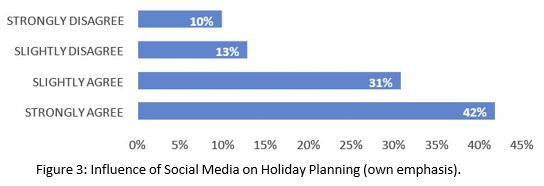
Tracking back to our statistics revealed from the primary research, it is apparent from the summary of the whole exercise and the various findings of the research that social media has a very profound and considerable impact as a whole on the tourism industry. On average, the results from this study showed that social media had become part and parcel with the tourism sector and where it was not apparent that this phenomenon is equally important, it was then the time for authorities to take the gauntlet and utilize its many values that could be used to enhance the image of that destination hence ensuring growth figures in future tourists visiting that certain place. The below figure for example shows that more than 70% agree that the social media has a great influence on their holiday planning.
Conclusion
This research created some multi-dimensional approaches in which it could have been undertaken, however, a strong argument and submission is made that the approach adopted in this instance was the most appropriate in the circumstances. To begin with, it was established that the tourism industry is a very large sector the world over. In essence this meant that a great many number of individuals get to engage in travel at some point in their lives with quite a large number doing so quite as frequently as once every year. As such it was established further that since gaining popularity from the mid-2000s, there are now also a huge number of organizations that now consider social media as a viable conduit through which potential visitors could be enticed.
The most basic conclusion then in this regard is that this research provided evidence of social media actors being amongst the biggest contributors of consumer information related to tourism destinations and tourism related issues in general. This was made possible through the various social media platforms where information was shared and other users could then access it quite easily and often without a charge (Munar & Jacobsen, 2013). From the information tabulated, it is also additionally prevalent that information sharing through these platforms is was achieved through use of gadgets such as mobile devices and in the form of videos, pictures and commentaries to such destinations or other tourism products.
Essentially then tourism service providers no longer enjoy the monopoly they used to enjoy in the past where they could drive and control information dissemination, with that power shift being felt with the very consumers they used to control over.
From this assertion then, it can be further concluded that social media indeed has become a cornerstone in the drive towards the evolution of the tourism sector. This is so because it was revealed in this research that social media did have an influence in assisting users to decide on their particular choice of destination and all this information at no cost to them probably save for network usage. Not only was this information
critically provided in its raw form in such platforms, but, it is highly possible that its usage could sway any decision to shy away from visiting that destination at the eleventh hour based on new information coming to the attention of the potential traveler. This would probably not have been the case should such information still be in the hands of businesses. Another advantage of this accessibility of the information is that it could easily assist both tourism service providers and destination makers with the opportunities to fine-tune their product offerings and for users to tailor plan their activities well in advance, armed with all the specific and accurate information gleaned from social media sites and platforms.
And lastly, an important conclusion based on the emotional inquisition of the study revealed that not all the participants had a huge dependence or reliability element of information contained on social media platforms. In some instances, the respondents simply intimated at the information being trustworthy, sincere and honest. These elements were concluded to be quite vital for users of social media platforms in reaching decisions regards their travel destinations. As such it was equally important that any user be certain regards fully engaging in activities based on decisions reached upon only from information from social media platforms.
Références bibliographiques
Akkawi, M. (2010). Resident attitudes towards tourism development in conservative cultures: The case of Qatar (Master’s thesis, University of Waterloo).
Anderson, J., & Rainie, L. (2012). Millennials will benefit and suffer due to their hyperconnected lives. Washington DC, Pew Research Center, 18-19.
Bell, E., Bryman, A., & Harley, B. (2015). Business research methods. Oxford university press.
Bethapudi, A. (2013). The role of ICT in tourism industry. Journal of Applied Economics and Business, 1(4), 67-79.
Bowen, G., & Bowen, D. (2016). Social media: strategic decision making tool.
In Competitive Social Media Marketing Strategies (pp. 94-111). IGI Global.
Brotherton, B. (2015). Researching hospitality and tourism. Sage.
Chatzigeorgiou, C. (2017). Modelling the impact of social media influencers on behavioural intentions of millennials: The case of tourism in rural areas in Greece.
Conrady, R., & Buck, M. (2007). Trends and Issues in Global Tourism… Berlin: Springer.
DIFI. (2018), The Impact of the Blockade on Families in Qatar, https://www.difi.org.qa/wp-content/uploads/2018/07/Blockade-English-FINAL.pdf, Accessed on 03/11/2019. –
Dwivedi, M., Yadav, A., & Venkatesh, U. (2011). Use of social media by national tourism organizations: a preliminary analysis. Information Technology & Tourism, 13(2), 93-103.
Eveland Jr, W. P., & McLeod, D. M. (1999). The effect of social desirability on perceived media impact: Implications for third-person perceptions. International Journal of Public Opinion Research, 11(4), 315-333.
Fotis, J. N., Buhalis, D., & Rossides, N. (2012). Social media use and impact during the holiday travel planning process (pp. 13-24). Springer-Verlag.
Fotis, J., Buhalis, D., & Rossides, N. (2011). Social media impact on holiday travel planning: The case of the Russian and the FSU markets. International Journal of Online Marketing (IJOM), 1(4), 1-19.
France24. (2019), Controversy overshadows Qatar’s preparations for 2022 FIFA World Cup, https://www.france24.com/en/20190927-focus-qatar-2022-world-cup, Accessed 05/11/2019.
Ghannam, J. (2011). Social Media in the Arab World: Leading up to the Uprisings of 2011. Center for international media assistance, 3(1), 1-44.
Goodrich, K., & De Mooij, M. (2014). How ‘social’are social media? A cross-cultural comparison of online and offline purchase decision influences. Journal of Marketing Communications, 20(1-2), 103-116.
Govers, R. (2012). Brand Dubai and its competitors in the Middle East: An image and reputation analysis. Place Branding and Public Diplomacy, 8(1), 48-57.
Hospitalitynet.org. (2018), The Value of Social Media in the Hospitality Industry, https://www.hospitalitynet.org/opinion/4086981.html, Accessed 05/11/2019.
Hudson, S., Roth, M. S., Madden, T. J., & Hudson, R. (2015). The effects of social media on emotions, brand relationship quality, and word of mouth: An empirical study of music festival attendees. Tourism management, 47, 68-76.
Internet Technology Reports, https://www.internetworldstats.com/emarketing.htm, Accessed 05/11/2019.
Internet world stats. (2019), Internet Growth Statistics: Today’s road to e-Commerce and Global Trade
Kothari, C. R. (2004). Research methodology: Methods and techniques. New Age International.
Kotler, P., & Gertner, D. (2002). Country as brand, product, and beyond: A place marketing and brand management perspective. Journal of brand management, 9(4), 249-261.
Krippendorf, J. (2010). Holiday makers. Taylor & Francis.
Lange, D. B., Yang, H. C., Zhang, X., Wheeler, G. A., Joyce, J. J., Moore, D. M., & Pandit, B. (2016). U.S. Patent No. 9,294,576. Washington, DC: U.S. Patent and Trademark Office.
Louis, C., Lawrence, M., & Keith, M. (2007). Research methods in education. New York: Routledge.
Mariani, M. M., Buhalis, D., Longhi, C., & Vitouladiti, O. (2014). Managing change in tourism destinations: Key issues and current trends. Journal of Destination Marketing & Management, 2(4), 269-272.
MoTC. (2013), Social Media Use in Qatar: Key insights from 2013, http://www.motc.gov.qa/sites/default/files/social_media_use_in_qatar_2013_0_1.pdf, Accessed on 03/11/2019.
MoTC. (2014), Understanding Emerging Social Media Platforms in Qatar, http://www.motc.gov.qa/sites/default/files/social_media_research_summary_english_ final.pdf, Accessed on 03/11/2019.
Power, D. J., & Phillips-Wren, G. (2011). Impact of social media and Web 2.0 on decision-making. Journal of decision systems, 20(3), 249-261.
Scaife, L. (2014). Handbook of social media and the law. CRC Press.
Sobaih, A. E. E., & Moustafa, M. A. (2016). Speaking the same language: The value of social networking sites for hospitality and tourism higher education in
Egypt. Journal of Hospitality & Tourism Education, 28(1), 21-31.
Suri, H. (2011). Purposeful sampling in qualitative research synthesis. Qualitative research journal, 11(2), 63-75.
The Peninsula. (2018), Social media is indispensable to Qatari students, https://thepeninsulaqatar.com/views/political-views/368494/social-media-is- indispensable-to-qatari-students, Accessed on 03/11/2019.
Thomas, D. R. (2006). A general inductive approach for analyzing qualitative evaluation data. American journal of evaluation, 27(2), 237-246.
Traveller. (2010), If you leave here, can he come too? https://www.traveller.com.au/if-you-leave-here-can-he-come-too-10dj0, Accessed 12/01/2020.
Veal, A. J. (2017). Research methods for leisure and tourism. Pearson UK.
Xiang, Z., & Gretzel, U. (2010). Role of social media in online travel information search. Tourism management, 31(2), 179-188.
Zeng, B., & Gerritsen, R. (2014). What do we know about social media in tourism? A review. Tourism management perspectives, 10, 27-36.
Živković, R., Gajić, J., & Brdar, I. (2014). The Impact of social media on tourism. Singidunum Journal of Applied Sciences, 758-761.